
Defensible Space Clearing in Marin County
Trees and brush cleared back so your home has room to breathe in fire season.
Free estimate, no obligation.
or get a free estimateMuch of Marin sits right where houses meet wildland. Homes in Fairfax and the upper streets of San Anselmo back onto oak woodland and open space, and the same is true on the ridges above Novato and Mill Valley. When fire weather comes in late summer and fall, what grows close to the house matters more than almost anything else. Embers carried ahead of a fire land in dry leaves, low branches and brush, and that's how many homes catch. California law asks every homeowner in these areas to keep 100 feet of defensible space around the house, and local fire agencies in Marin check for it. Inspectors walk neighborhoods every year, and the list of fixes they leave behind is usually about trees and brush more than anything else.
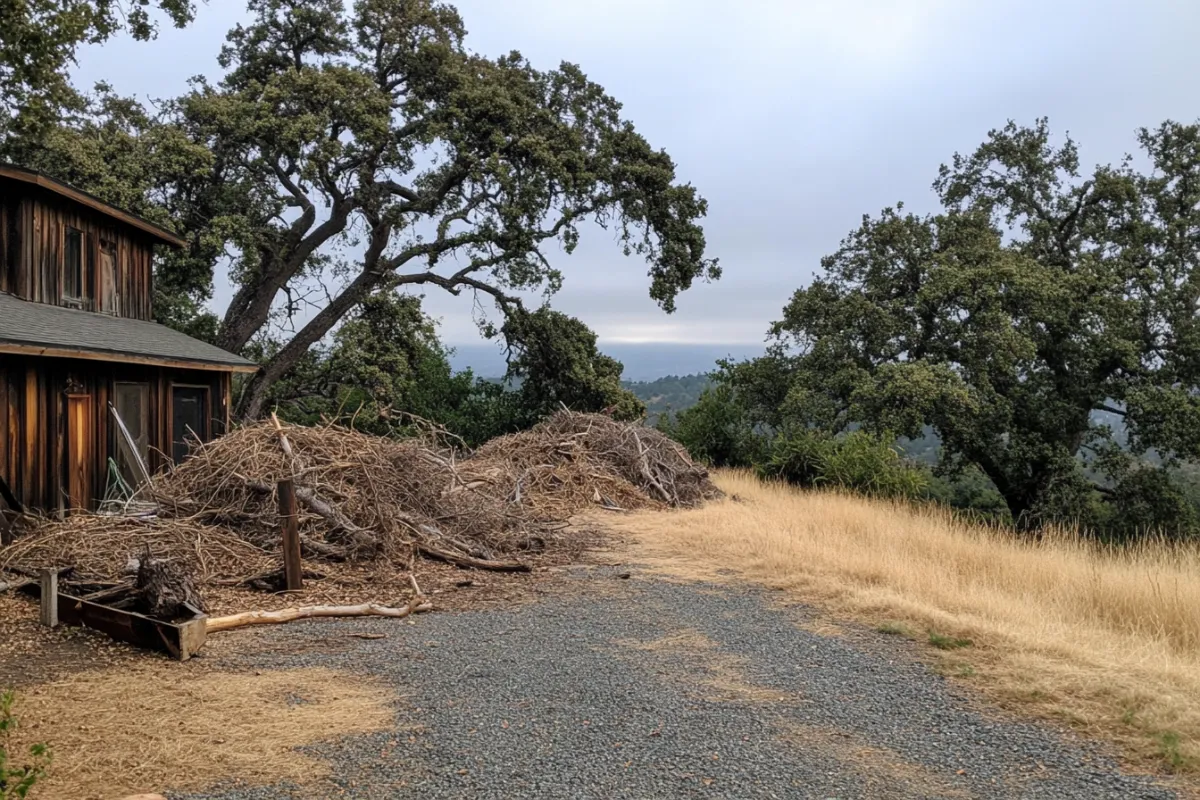
Here we lay out the signs your property needs work, how the three defensible space zones work, what our clearing visit looks like, and when to schedule it each year. Much of the job overlaps with regular tree trimming and pruning, so it often makes sense to do both in one visit.
Questions about a tree?
Call TRACKING NUMBERSigns Your Property Needs Clearing
Start at the house and look up. Branches hanging over the roof or within reach of the chimney are the first thing an inspector notices. Low limbs that start near the ground let a grass fire climb straight into the canopy, which is called a ladder fuel. Shrubs packed tight under trees do the same thing. Look at the ground too: piles of dead leaves against the walls, dry grass taller than your ankle, and firewood stacked next to the house all count against you. If your fire department has left a notice after an inspection, that tells you exactly which items to fix first.
The Three Zones in Plain English
Defensible space is measured out from the house in rings. The first five feet is called Zone 0, the ember-resistant zone. Nothing that burns should be here: no plants, no bark mulch, no leaf piles, no wood furniture. Zone 1 runs out to 30 feet. Dead plants, dry grass and fallen leaves come out, and firewood moves farther away. Zone 2 covers the next 70 feet, out to 100 feet total, where grass stays cut to four inches or less. Across all the zones, Marin County Fire asks that tree branches stay at least six feet off the ground, at least six feet from the roof and at least ten feet from a chimney, with trees and shrubs spaced about ten feet apart. On a slope, those gaps need to be wider, since fire runs uphill faster. It sounds like a lot of rules, but on most lots the work comes down to a few trees, some brush and a good cleanup.
What Our Clearing Visit Covers
We tour the property with you and mark what needs to go, starting closest to the house and working out. Crews limb trees up to the right height, cut back branches over the roof and chimney, and thin out shrubs that are bunched under trees. Dead trees and brush come out. We clean leaves and needles off the roof and out of the gutters where trees have filled them. Everything we cut gets chipped and hauled away or spread thin where that's allowed, never left in a pile, because a pile of brush is fuel too. If you have an inspection report, we work from it line by line.
When to Schedule It
Spring is the best time, after the rains end and before grass dries out. That gives you a cleared property before the most dangerous months, which in Marin usually run from late summer into fall when offshore winds pick up. Most yards need a yearly touch-up, since grass grows back and branches keep reaching for the roof. Bigger jobs, like removing several trees or clearing a steep slope, are easier to schedule in winter and early spring, before every crew in the county is booked.
If a dead or dying tree sits inside your 100 feet, our tree removal crew can take it out during the same visit.
Frequently Asked Questions
It's the buffer of cleared and thinned plants around a home that slows a wildfire down and gives firefighters room to work. In California it's measured out to 100 feet from the house, in three zones, with the strictest rules in the first five feet. A home with good defensible space is much less likely to catch from embers or from flames moving through the yard.
Usually not. The rules focus on spacing and clearance, not bare ground. Most mature trees can stay if their lower limbs are raised, their branches are cut back from the roof and chimney, and the brush underneath is cleared. Trees that are dead, dying or crowded right against the house are the ones that most often need to come out.
Plan on a check every year, ideally in spring. Grass grows back, leaves build up and branches keep growing toward the roof, so a property that passed last year can fall behind fast. A yearly visit keeps it in shape and usually takes much less work than the first big clearing.
Call for a free estimate
Call [TRACKING NUMBER]