
Tree Trimming and Pruning in Marin County
Lighter, healthier trees that stay off your roof.
Free estimate, no obligation.
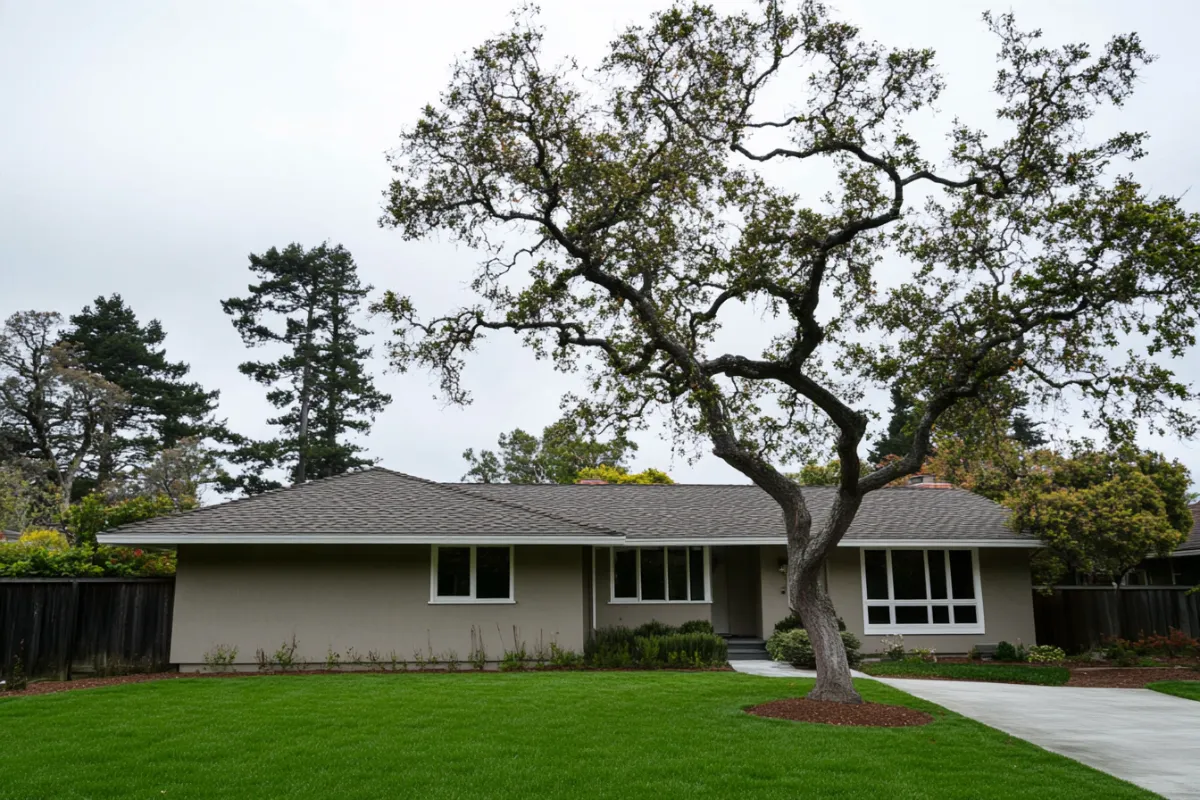
or get a free estimateMost trees don't need to come down. They need a good trim. A coast live oak with limbs resting on the roof, a bay laurel that's grown so thick it blocks every bit of light, a row of pines sending needles into the gutters every week. Pruned the right way, each of those trees can stay for decades and be safer for it. Our crews trim everything from big backyard oaks in Novato to the crowded hillside lots of San Anselmo, where one overgrown tree can shade three houses.
Here you'll find the signs your trees are due, the main pruning cuts and their purpose, how a trimming visit runs, and how often Marin trees really need it. If a tree is too far gone to save, we'll tell you plainly and talk through tree removal instead.
Questions about a tree?
Call TRACKING NUMBERSigns Your Trees Are Due for a Trim
The easy ones to spot are limbs touching the roof, scraping the siding or hanging low over the driveway. Branches that rub the house in wind wear through shingles and give rats and squirrels a bridge onto the roof. Look up, too. Dead branches in the crown, sometimes called deadwood, break off in the first good storm. A canopy so dense you can't see sky through it catches a lot of wind, like a sail. Limbs growing toward power lines are another sign, though work right next to energized lines is the utility's job, not ours. And if the tree hasn't been trimmed since you moved in, it's probably time for a look. Fire season adds one more reason. Limbs hanging over the roof drop leaves and needles into gutters, and dry debris up there is exactly what wind-blown embers land in. Clearing those limbs back does double duty.
Thinning, Raising and Reducing: What Each Cut Does
Pruning isn't one thing. Crown thinning takes out selected branches through the canopy so light and wind pass through, which lowers the strain on the tree in a storm. Crown raising removes lower limbs to clear the roof, a walkway or a view. Crown reduction shortens the longest limbs back to a healthy side branch, which makes a tall tree smaller without wrecking its shape. Deadwooding removes dead branches. What we don't do is topping, which means cutting the main stems off flat across the top. It looks tidy for a season, then the tree sprouts weak, crowded shoots that break easily. A widely used guideline is to take no more than about a quarter of a tree's live canopy in one year. Take much more than that and the tree is left short on leaves to feed itself, which sets it up for decay and pests. A good trim should leave a tree that still looks natural from the street.
How a Trimming Job Goes
We start by walking around the tree with you and agreeing on what you want: clearance off the roof, more light, less wind load, or all three. Then you get a written price. On the day, a climber goes up on ropes or we use a lift where the yard allows it. Each cut is made just outside the branch collar, the slightly swollen ring where a branch meets the trunk, so the wound can seal over. Branches come down on ropes over roofs and gardens. We chip the brush, rake the yard and blow off hard surfaces before we leave. A typical job on one or two large trees takes a few hours. A full property with a dozen trees can take a day or more, and we'll tell you which when we quote it.
How Often Marin Trees Need Pruning
Most mature trees do well with a trim every three to five years. Fast growers like eucalyptus, acacia and some pines can need it more often, especially near houses. Young trees benefit from a light structural prune every couple of years so they grow a strong shape early. Timing matters here too. Late fall and winter suit most trees, while oaks are best pruned in the dry months, since wet weather is when the sudden oak death pathogen spreads. Fruit trees and flowering ornamentals each have their own best season, and we'll time the work to suit what's growing on your lot. If you're not sure when your trees were last done, the canopy usually tells us.
If your main worry is a tree that looks unstable rather than overgrown, start with a hazard tree assessment.
Frequently Asked Questions
People use the two words for the same work, and so do we. Some arborists use "pruning" for cuts made for the tree's health and structure, and "trimming" for shaping and clearance around a house. In practice a good job does both: it clears the roof and the walkways while leaving the tree balanced, healthy and better able to handle wind.
Yes. Cutting the main stems flat across the top, called topping, stresses the tree and opens big wounds that decay can get into. The tree answers with a burst of thin shoots that are weakly attached and break easily, so it ends up more dangerous than before. If a tree is too tall, crown reduction is the better way to bring it down in size.
In California you can generally trim branches that hang over your property line, back to the line, as long as the work doesn't seriously harm or kill the tree. It's always smart to talk with your neighbor first. We're glad to look at the property line together and trim the overhang in a way that keeps the tree healthy on both sides of the fence.
Call for a free estimate
Call [TRACKING NUMBER]